

Agile Coaches
Agile coaches play a key role in helping teams and organizations adopt agile methods. These skilled professionals guide teams through the challenges of implementing agile practices.
They work with everyone from developers to executives to create a more flexible and responsive work culture.

Agile coaches mentor both leaders and team members to overcome resistance to change and embrace agile principles. They teach agile frameworks like Scrum and Kanban, but their job goes beyond just explaining processes.
Agile coaches help shift mindsets and behaviors to create lasting organizational change.
The demand for agile coaches has grown as more companies seek to become agile. A good agile coach blends technical know-how with strong people skills. They must understand agile methods deeply while also being able to communicate and influence others effectively.
Key Takeaways
- Agile coaches guide teams and organizations in adopting agile practices
- They work across all levels of an organization to create cultural change
- Effective agile coaches combine technical expertise with strong interpersonal skills
The Role of an Agile Coach
Agile coaches play a key part in helping teams and companies use agile methods. They teach agile skills, guide teams, and help make work smoother.
Agile Coach vs Scrum Master
An agile coach helps whole companies use agile ways of working. A Scrum Master focuses on one team using Scrum.
Agile coaches work with many teams and leaders. They look at the big picture of how the company works.
Agile coaches teach agile ideas to everyone. Scrum Masters make sure their team follows Scrum rules.
Coaches help solve problems across teams. Scrum Masters help their own team get better at Scrum.
Both roles need strong people skills. But agile coaches need more experience with different agile methods.
Responsibilities and Skills
Agile coaches have many jobs. They teach teams about agile practices. They help fix team problems. They also work with company leaders to make big changes.
Key skills for agile coaches:
- Deep knowledge of agile methods
- Strong communication
- Problem-solving
- Teaching ability
- Leadership
Coaches need to be good listeners. They must understand team issues. Then they can give the right advice to help.
Agile coaches also need to be flexible. Every team and company is different. Coaches must adapt their style to fit each situation.
Contribution to Agile Teams
Agile coaches help teams work better together. They teach agile values like trust and openness. This makes team work smoother.
Coaches show teams how to:
- Plan work better
- Talk to each other more
- Solve problems faster
They help teams learn from their mistakes. This leads to ongoing improvement.
Coaches also help teams work well with other groups in the company.
Agile coaches guide teams to be more self-reliant. They teach skills so teams can solve their own problems. This helps teams keep getting better even when the coach isn’t there.
Agile Frameworks and Practices

Agile coaches use various frameworks and practices to help teams improve their work processes. These approaches focus on flexibility, collaboration, and delivering value quickly.
Popular Agile Methodologies
Agile methodologies include Scrum, Kanban, and Lean.
Scrum uses sprints to break work into short cycles. Teams plan, execute, and review their work in these sprints.
Kanban focuses on visualizing work and limiting work-in-progress. It helps teams manage their workflow more effectively.
Lean aims to reduce waste and maximize value. It encourages teams to focus on what’s truly important to customers.
These methods share common agile principles like customer focus, adaptability, and continuous improvement.
Adaptability and Continuous Improvement
Agile frameworks stress the need to adapt to change. Teams regularly reflect on their process and adjust as needed.
Continuous improvement is a key part of agile. Teams hold retrospectives to discuss what went well and what could be better.
This approach helps teams learn from experience and get better over time. It also allows them to respond quickly to new information or changing needs.
Agile coaches guide teams in these practices, helping them become more flexible and efficient.
Leveraging Scrum and Kanban
Scrum and Kanban are two popular agile frameworks.
Scrum uses fixed-length sprints and defined roles like Scrum Master and Product Owner.
Kanban uses a board to visualize work and focuses on flow. Teams pull work items through stages as capacity allows.
Some teams combine these methods, creating a hybrid approach called Scrumban. This allows them to use the best parts of each framework.
Agile coaches help teams choose and implement the right mix of practices for their needs. They guide teams in adapting these frameworks to fit their specific context.
Professional Development

Agile coaches have many options to grow their skills and advance their careers. Ongoing learning and certifications play a key role in their professional journey.
Certifications and Training
Agile certifications are crucial for coaches to prove their expertise.
The Scrum Alliance offers popular credentials like the Certified Scrum Master. This certification shows a deep understanding of Scrum methods.
ICAgile provides the ICAgile Certified Professional credential. It covers a wide range of Agile topics beyond just Scrum.
For those aiming higher, the Certified Enterprise Coach (CEC) is a top-tier certification. It’s for coaches who work with large organizations.
Many training programs exist to help coaches earn these certifications. These courses teach Agile principles, coaching techniques, and leadership skills.
Career Progression for Agile Coaches
Agile coaches can follow various career paths as they gain experience. Many start as team-level coaches, working directly with small groups.
As they grow, coaches may become senior Agile coaches. These roles often involve mentoring other coaches and handling more complex projects.
The highest level is usually an enterprise Agile coach. These professionals guide entire organizations through Agile transformations.
Agile coach salaries tend to increase with experience and certifications. Enterprise coaches typically earn the highest pay due to their broad impact.
Coaches can also specialize in certain industries or Agile methods. This specialization can lead to unique career opportunities and higher earnings.
Challenges in Agile Coaching

Agile coaches face several key obstacles in their work. These include guiding organizational shifts, managing team interactions, and fostering a new mindset and culture.
Managing Organizational Change
Agile coaches often struggle with resistance to change in organizations. Many companies have deep-rooted traditional practices that are hard to alter.
Coaches must navigate complex organizational structures and convince leaders of the benefits of agile methods. This requires strong communication and persuasion skills.
Another challenge is aligning different departments and teams. Agile coaches need to create a unified vision across the organization.
Implementing new processes and tools can also be difficult. Coaches must balance introducing changes while maintaining productivity.
Facilitating Team Dynamics
Team dynamics pose unique challenges for agile coaches. They must help teams develop trust and open communication.
Coaches often deal with conflicts between team members. They need skills in mediation and conflict resolution.
Creating a collaborative environment is crucial but can be tough. Coaches must break down silos and encourage knowledge sharing.
Balancing individual and team goals is another hurdle. Agile coaches need to foster a sense of shared responsibility.
Adapting to different personalities and work styles within a team requires flexibility from coaches.
Case Studies and Success Stories
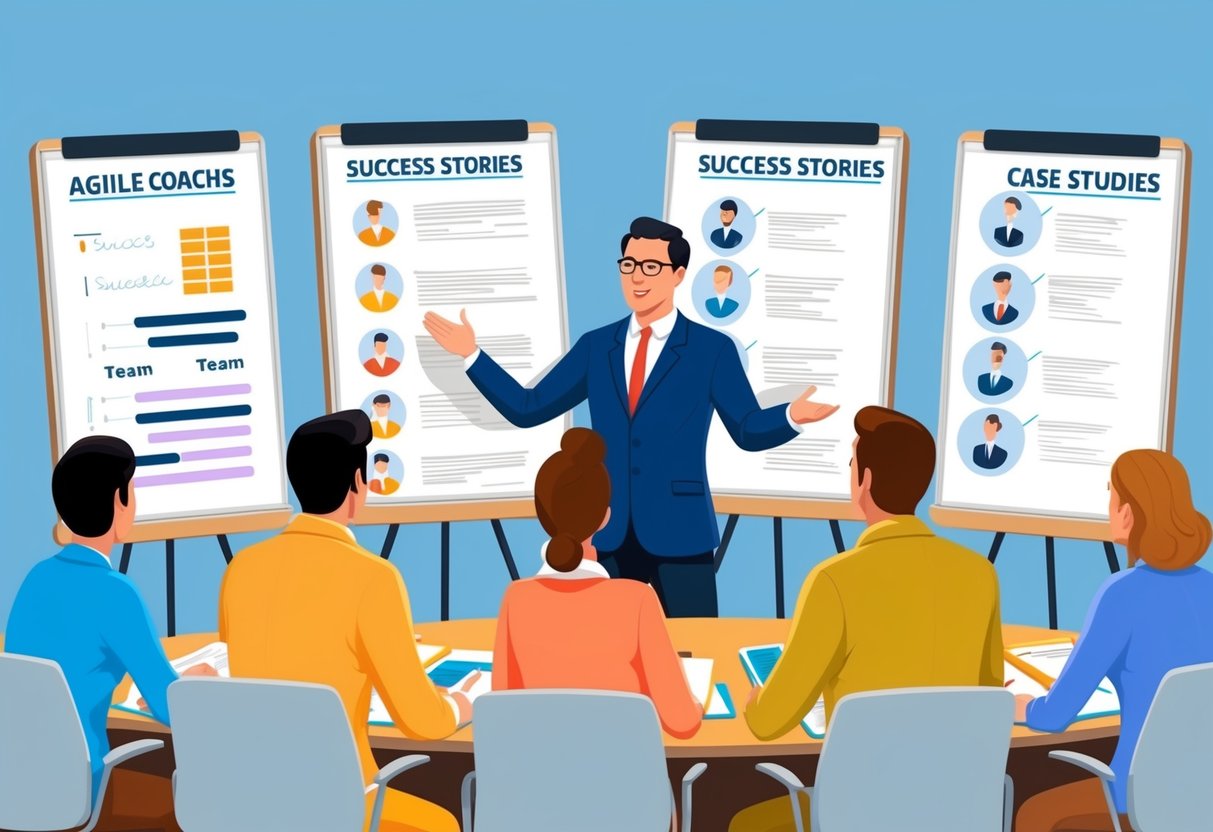
Agile coaches have played a key role in many successful agile transformations.
Let’s look at some real-world examples.
ING Bank started their agile journey with a pilot project in digital banking. They brought in agile coaches to guide teams in adopting Scrum practices.
The pilot’s success led to a company-wide rollout affecting over 5,000 employees.
LEGO began scaling agile in 2015 using the Scaled Agile Framework (SAFe). Agile coaches helped product owners and teams adjust to new ways of working.
This boosted innovation and reduced time-to-market for new products.
Agile transformations can benefit companies of all sizes.
Small startups and large enterprises alike have seen improvements in:
- Team collaboration
- Product quality
- Customer satisfaction
- Time to market
- Employee engagement
Enterprise agile coaches often work with leadership to drive change across organizations.
They help align teams, remove barriers, and foster an agile mindset.
Many success stories highlight the importance of patience and persistence.
Agile transformations take time, but the results can be transformative.
Companies report increased agility, faster innovation, and better ability to respond to market changes.

 TechPowered
Leave a comment