

Introduction
Artificial intelligence is changing how businesses operate and compete.
Companies that implement AI effectively can gain major advantages in efficiency, customer service, and decision-making.
The key to successful AI implementation is developing a clear strategy aligned with business goals and choosing the right approach for your organization.

There are different ways to bring AI capabilities into a company.
Some build custom AI solutions in-house, while others use pre-built AI software or partner with AI vendors.
The best method depends on factors like budget, timeline, and in-house expertise.
No matter the approach, having a strategic roadmap is crucial for AI success.
AI implementation takes careful planning, but it can deliver big results.
Companies that use AI well often see improved productivity, reduced costs, and new revenue opportunities.
With the right strategy, AI can become a powerful tool for business growth and innovation.
Key Takeaways
- AI implementation requires a clear strategy aligned with business objectives
- Companies can build AI in-house, use pre-built solutions, or partner with vendors
- Effective AI use can boost productivity, cut costs, and create new opportunities
AI Implementation Fundamentals

Putting AI into practice requires a strong grasp of key technologies and a well-planned strategy.
Organizations must focus on matching AI tools to business goals and building the right team and infrastructure.
Understanding AI Technologies
AI covers a range of tools and methods.
Machine learning uses data to improve over time. Meanwhile, deep learning mimics human brain networks, and natural language processing helps computers understand text and speech.
Key AI technologies include:
- Predictive analytics
- Computer vision
- Robotics
- Expert systems
Organizations should pick AI tech that fits their needs.
A retail company might use computer vision for inventory, while a bank could apply predictive analytics to detect fraud.
AI needs lots of quality data to work well. So, companies must have good data collection and storage systems in place.
Building an AI Strategy
A strong AI strategy links to business goals. It should focus on areas where AI can have the biggest impact.
Steps to build an AI strategy:
- Set clear objectives
- Choose high-value projects
- Get leadership buy-in
- Build an AI team
- Plan for data and tech needs
Start with small projects to show value. This builds support for bigger AI efforts. Make sure to follow AI implementation best practices.
Training staff on AI is key. Everyone should know how AI fits into their work. This helps with adoption across the company.
Measure results to prove AI’s worth. Track both financial and non-financial benefits. Use these wins to expand AI use over time.
AI in Business: Gaining a Competitive Edge

AI is transforming how companies operate and compete. It offers new ways to boost efficiency, innovate, and get ahead of rivals.
AI Applications and Industry Adoption
Many businesses now use AI to improve their products and services. An estimated 35% of companies already use AI to gain an edge.
Some common AI applications include:
• Chatbots for customer service • Predictive analytics for forecasting • Computer vision for quality control • Natural language processing for content creation
Different industries adopt AI at varying rates.
Finance and tech firms tend to be early adopters, while healthcare and manufacturing are catching up quickly.
Companies that don’t embrace AI risk falling behind. AI can help businesses:
• Cut costs • Speed up processes • Make better decisions • Personalize offerings
Driving Business Value with AI
To get real value from AI, companies need a clear strategy. Simply buying AI tools isn’t enough. Firms must integrate AI into their core business processes.
Some key ways AI drives value include:
- Automating routine tasks
- Uncovering insights from data
- Enhancing products and services
- Improving customer experiences
AI also enables new business models. For example, AI powers recommendation engines for streaming services.
To succeed with AI, companies should:
• Identify specific use cases
• Collect quality data
• Build AI skills in-house
• Partner with AI experts when needed
Machine Learning Deep Dive

Machine learning transforms raw data into valuable insights. It uses smart algorithms to find patterns and make predictions. Deep learning takes this a step further with complex neural networks.
From Data to Insights: Machine Learning Methods
Machine learning uses data to learn and improve without being explicitly programmed. It has two main types: supervised and unsupervised learning.
Supervised learning uses labeled data to train models. It’s great for tasks like spam detection or image classification. The algorithm learns from examples with known outcomes.
Unsupervised learning finds hidden patterns in unlabeled data. It’s useful for clustering similar items or detecting anomalies. This method can reveal unexpected insights in complex datasets.
Both methods rely on large amounts of high-quality data. They also need powerful computers to process information quickly.
The Significance of Deep Learning Technologies
Deep learning is a subset of machine learning that uses artificial neural networks. These networks are inspired by the human brain’s structure.
Deep learning excels at handling unstructured data like images, text, and sound. It can automatically learn important features without human input.
This technology powers many modern AI applications. Examples include voice assistants, self-driving cars, and advanced medical diagnosis tools.
Deep learning models can be very large and complex. They often require specialized hardware like GPUs to train effectively. Despite these challenges, deep learning continues to push the boundaries of what’s possible in AI.
Data: The Foundation of AI Success

Good data is key for AI to work well. It needs lots of accurate information to learn from. Companies must organize and share their data properly.
Training Data and Data Standardization
AI systems learn from training data. This data must be high-quality and represent real-world situations. Clean, labeled data helps AI models make better decisions.
Data standardization is crucial. It means putting information in a consistent format. This makes it easier for AI to understand and use the data.
Companies should create clear rules for data collection and storage. They need to check data quality often. Bad data can lead to wrong AI results.
Clear goals are important when preparing data for AI. Teams should know what they want the AI to do. This helps them choose the right data to use.
Data Sharing and Interoperability
Data sharing helps AI learn more. Different departments or companies can work together. This gives AI access to more diverse information.
Interoperability means systems can talk to each other. It allows data to move easily between different tools and platforms. This is key for AI to use data from many sources.
Companies should set up secure ways to share data. They need to follow privacy laws and protect sensitive information. Clear agreements help manage data sharing between groups.
Good data sharing and interoperability make AI more powerful. They let AI use more information to make better choices.
The Rise of Ethical AI

As AI becomes more prevalent in healthcare, ethical concerns have emerged. Transparency and patient safety are key priorities. New regulations aim to ensure AI systems are used responsibly.
Transparency and Patient Safety
AI algorithms used in healthcare need to be transparent. Doctors and patients should understand how AI makes decisions.
Explainable AI helps build trust. It allows people to see why an AI system reached a certain conclusion.
AI systems must protect patient privacy. Strong data security measures are crucial.
Healthcare providers need to get informed consent before using AI. Patients should know when AI is part of their care.
AI can improve patient safety by catching errors. It can flag potential drug interactions or unusual test results.
But AI systems can also make mistakes. Humans must stay involved to catch AI errors.
Regulation and Ethical Considerations
The regulatory environment for AI in healthcare is evolving. New laws and guidelines are being developed. These aim to ensure AI is used ethically and safely.
Key ethical issues include:
- Bias in AI algorithms
- Data privacy
- Accountability for AI decisions
- Impacts on healthcare jobs
The Office of Management and Budget (OMB) is working on AI regulations. These will cover federal agencies’ use of AI. Rules for private sector AI are also being considered.
Ethical AI frameworks are being adopted. These provide guidelines for developing and using AI responsibly. Regular audits of AI systems can help catch problems early.
Healthcare Transformation through AI

AI is changing healthcare in big ways. It helps doctors make better choices and gives patients more personal care. Let’s look at how AI is used in hospitals and for custom treatments.
AI in Clinical Implementation
AI helps doctors work smarter. It can read x-rays and find problems fast. This saves time and catches issues early.
AI also helps pick the best medicine for each person.
Hospitals use AI to keep track of patients. It watches for signs that someone might get sicker. This lets nurses help before things get bad.
AI can also spot patterns in lots of patient data. This helps find new ways to treat illnesses.
Some AI tools help with paperwork. They write notes and fill out forms. This gives doctors more time with patients.
AI can also help schedule appointments and remind people to take medicine.
AI for Personalized Treatment in Digital Health
AI makes healthcare fit each person better. It looks at a patient’s genes, lifestyle, and health history. Then it suggests treatments that might work best for them.
Apps use AI to give health advice. They can track things like exercise, sleep, and diet. The AI learns what works for each person. It then gives tips to help them stay healthy.
AI can also predict health problems before they happen. It looks at lots of data to spot risks. This helps doctors and patients take action early.
Some AI tools even help make custom medicine or treatment plans.
AI chatbots answer health questions day and night. They give quick info and tell people when to see a doctor. This helps more people get health advice when they need it.
Federal Agencies and AI
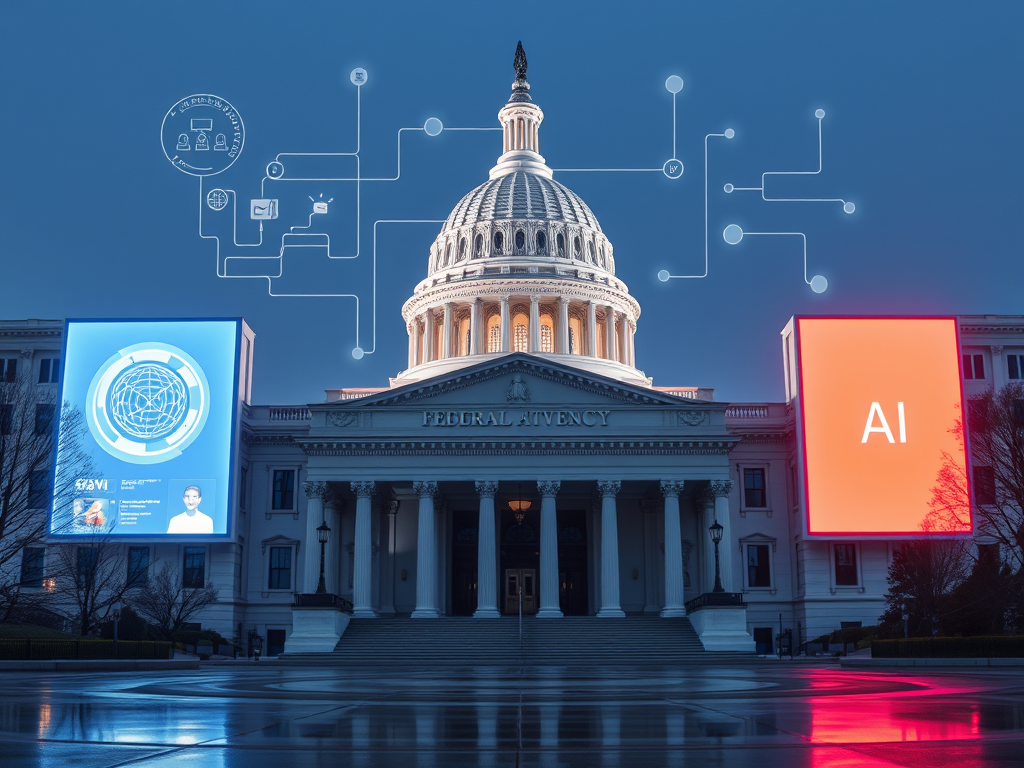
Federal agencies are adopting AI to improve services and operations. AI is changing how agencies work and serve the public. The impact spans healthcare regulation to government innovation efforts.
Software as a Medical Device (SaMD)
The FDA regulates AI-powered medical software. They created rules for Software as a Medical Device. These rules make sure AI medical tools are safe and work well.
The FDA looks at how AI learns and changes over time. They want to be sure updates don’t make the software unsafe.
The agency also checks if AI systems are fair to all groups.
Companies must show their AI medical software is reliable. They need to prove it gives correct results. The FDA asks for ongoing monitoring of AI performance.
AI for Public Sector Innovation
Federal agencies use AI to serve citizens better. The technology helps them work faster and smarter.
Some agencies use AI chatbots to answer questions. This cuts wait times for people who need help.
AI also helps spot fraud in government programs.
Agencies like NASA use AI to process huge amounts of data. This speeds up research and discoveries. The military uses AI for things like maintaining equipment.
AI helps make government websites easier to use. It can translate content into many languages. This makes services more accessible to everyone.
AI and The Future of Work
AI is changing how we work. It brings new tools for customer service and ways to train workers.
AI Solutions for Enhanced Customer Service
AI chatbots help companies talk to customers 24/7. These bots can answer questions and solve simple problems fast. This saves time for both customers and staff.
AI also helps workers find info quickly. It can search through data and give useful answers. This makes customer service reps more helpful.
Some AI tools can spot trends in customer feedback. This helps companies fix issues before they become big problems.
Preparing the Workforce with AI Training Programmes
Many jobs now need AI skills. Companies are setting up training to teach workers about AI.
These programs cover basics like how AI works and its uses. They also teach hands-on skills for using AI tools.
Some training focuses on ethics in AI. This helps workers use AI in a fair and responsible way.
AI can also make training better. It can create custom lessons for each worker based on what they need to learn.
Conclusion
AI implementation brings many benefits to businesses and organizations. It can boost efficiency, cut costs, and open up new possibilities.
Some key areas where AI shines include automation, data analysis, and customer service.
But AI also comes with challenges. Privacy concerns, job disruption, and ethical issues need careful consideration. Organizations must plan thoughtfully when adopting AI.
The future of AI looks bright. As the technology improves, we’ll likely see it used in more creative and sophisticated ways. AI may transform industries we haven’t even imagined yet.
Successful AI implementation requires a balanced approach. Teams should focus on specific problems AI can solve. They should also invest in training and change management.
AI is a powerful tool, not a magic solution. Used wisely, it can drive innovation and growth. But it works best when combined with human skills and judgment.
As AI evolves, so will best practices for using it. Staying informed about AI trends and impacts will be crucial. With the right strategies, organizations can harness AI’s potential while managing its risks.

 TechPowered
Leave a comment